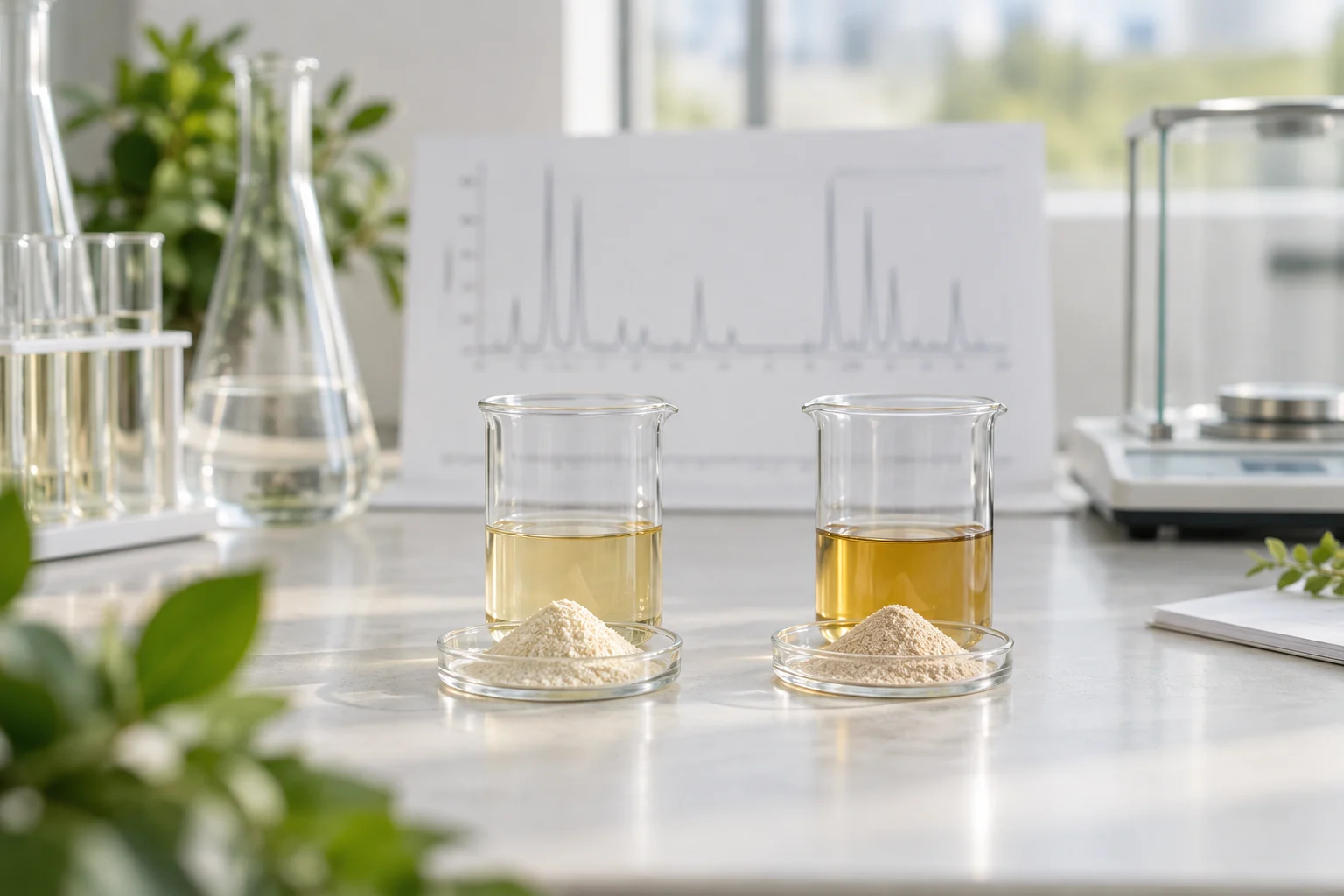
Fertilizer buyers often see “AA45” or “AA80” beside a second figure for free amino acids. Those figures answer different questions. Read them together, and ask how each was measured before comparing suppliers.
Free vs total amino acids at a glance
| Question | Free amino acids | Total amino acids |
|---|---|---|
| What is measured? | Unbound amino acids present in the sample. | Amino acids included by the specified total-content method, often after proteins and peptides are hydrolyzed for analysis. |
| Are peptide-bound amino acids included? | Generally excluded. | Generally represented after the analytical hydrolysis step, subject to method recovery and scope. |
| Does the number alone establish quality? | No. | No. |
| What else should be checked? | Amino acid profile; source and production process; nitrogen, chloride, moisture and pH; solubility test conditions; intended formulation and batch-specific COA. | |
Why the analytical method matters
A total amino acid assay commonly hydrolyzes proteins and peptides into their constituent amino acids before separation and measurement. A free amino acid assay omits that analytical hydrolysis and typically removes larger proteins and peptides first. Texas A&M University’s Protein Chemistry Lab describes this distinction in its amino acid analysis guidance.
“Total” does not mean that every amino acid is recovered equally under every procedure. Hydrolysis can alter or destroy certain amino acids, and laboratories may report different sets of analytes. Ask for the named method, the reported amino acids, and the basis of the percentage (for example, as received or dry basis). Do not calculate an exact peptide percentage by subtracting free from total unless the two tests are defined compatibly.
How can two AA80 powders have different free amino acid contents?
“AA80” describes a total amino acid grade or specification; it does not fully describe the balance between free amino acids and peptide-bound amino acids. Protein hydrolysates can contain free amino acids, oligopeptides and larger peptides. Their source material, process and degree of hydrolysis affect that composition. A peer-reviewed review of agricultural protein hydrolysates explains these differences.
A higher free amino acid figure is therefore a compositional fact, not a universal ranking of fertilizer performance. A buyer choosing between ingredients should match the full specification to the intended formulation, use rate and application conditions. For a grade comparison, review Everwell’s Amino Acids 45 and Amino Acids 80 product pages alongside their batch documents.
A practical COA checklist for buyers
- Identify the sample: batch number, sampling date and laboratory.
- Separate the claims: request total and free amino acid results as distinct line items, with units and reporting basis.
- Check the method: ask which hydrolysis, separation and quantification procedures were used and which amino acids were included.
- Read the profile: compare individual amino acids as well as the headline percentages.
- Check formulation properties: nitrogen, chloride, moisture, pH and relevant solubility test conditions.
- Test the intended use: run a small-scale dissolution or compatibility check in the actual water and formulation conditions. The total amino acid number does not establish solubility.
An example of what a report can show
Everwell publishes a representative Eurofins report for its AA80 grade (certificate AR-26-Y3-008791-02). The site reports 75.37% free amino acids for that tested sample under GB/T 18246-2019 and lists individual amino acids. This is an example of a documented test result, not a guarantee that every shipment has that exact value. Request the current batch COA and agreed specification for a purchase decision.
Frequently asked questions
Does a higher free amino acid percentage always mean a better fertilizer ingredient?
No. It describes part of the composition, not overall fitness for use. Compare total and free amino acids together with the amino acid profile, source, process, nitrogen, chloride, pH, solubility and your formulation requirements.
Can two AA80 products have different free amino acid contents?
Yes. AA80 usually refers to a total amino acid specification. Products can differ in their free amino acid and peptide fractions because raw materials and processing differ. Confirm the definitions and analytical methods on each supplier’s COA.
Is total amino acid content the sum of the free and peptide-bound fractions?
Only under compatible definitions, methods and reporting bases. Total amino acid tests often include an analytical hydrolysis step; recovery and the set of amino acids measured can differ. Do not calculate a precise peptide fraction by simple subtraction without method details.
What should a buyer request on a COA?
Request separate total and free amino acid results, the named analytical methods, sample or batch identity, reporting basis, amino acid profile, and other specification tests relevant to the intended formulation.
Sources and further reading
- Texas A&M University Protein Chemistry Lab — Amino Acid Analysis (analytical distinction between total and free amino acids).
- Biostimulant Properties of Protein Hydrolysates: Recent Advances and Future Challenges (composition and degree of hydrolysis).
- Eurofins AA80 representative report (Everwell sample-specific result).
Need to compare amino acid powder grades?
Tell us your target specification and formulation conditions. Ask for the current batch COA, method details and a sample before approval.