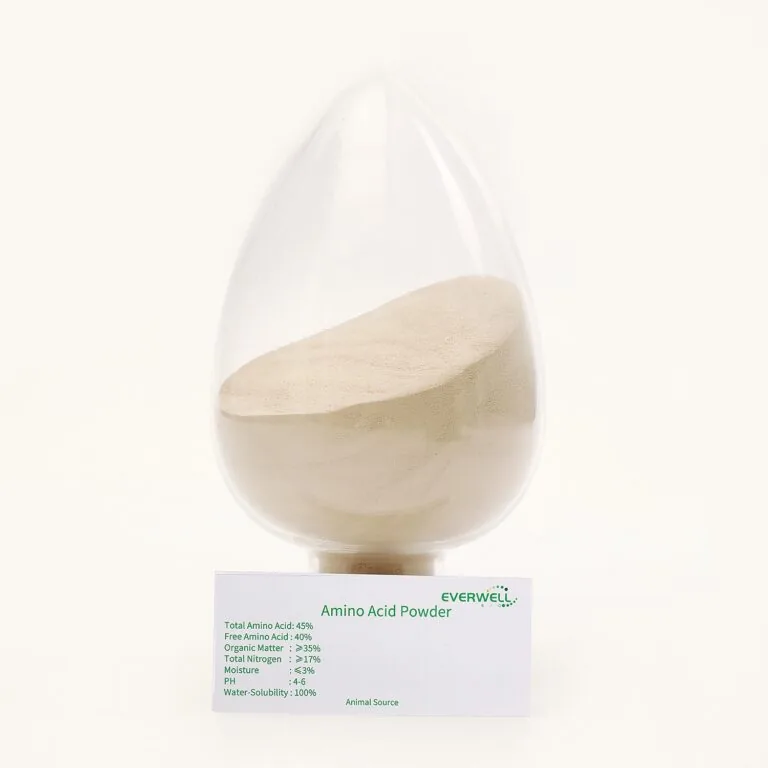
Amino Acid 45 is a water-soluble protein hydrolysate grade specified to contain at least 45% total amino acids. It is mainly supplied as a raw material for foliar fertilizers, fertigation products, water-soluble blends and other specialty crop-nutrition formulations.
The number “45” describes the total amino acid grade. It does not automatically mean that the product contains 45% free amino acids. This distinction is essential when comparing specifications and laboratory reports.
Total amino acids and free amino acids are different
Free amino acids are individual amino acid molecules that are not bound in peptides or proteins. Total amino acids are generally measured after laboratory hydrolysis and may include amino acids that were originally present in free form as well as amino acids released from peptides or protein fragments during analysis.
The result depends on the analytical method, sample preparation and reporting basis. Two certificates should not be compared until the buyer confirms that the methods and units are comparable.
For Everwell Bio’s current Amino Acids 45 product:
| Parameter | Current published specification or result |
|---|---|
| Total amino acids | ≥45% |
| Organic matter | ≥60% |
| Moisture | ≤5% |
| pH, 1% solution | 4–6 |
| Water solubility | 100% |
| Source | Hydrolyzed duck feather protein |
| Free amino acids | 41.93% in a recent independently tested sample |
The 41.93% free-amino-acid value applies to the tested sample. Buyers should request the batch COA for the material assigned to their order.
How Amino Acid 45 is produced
Protein hydrolysis breaks large protein structures into a mixture of amino acids, peptides and other soluble components. The exact distribution depends on the raw material, hydrolysis route, reaction control, purification and final formulation.
Process descriptions should match the actual grade. Terms such as “enzymatic,” “chemical,” “physical” or “natural” should not be used interchangeably. If the hydrolysis route or salt profile matters to the destination market, it should be confirmed in writing before purchase.
Where a 45% grade may be used
Amino Acid 45 may be evaluated for:
- foliar fertilizer formulations;
- fertigation and drip-irrigation products;
- water-soluble NPK or micronutrient blends;
- liquid concentrates after solubility and stability testing; and
- multi-component biostimulant formulations where permitted by local rules.
These are formulation categories, not universal registration or label claims. The finished product must comply with the destination market’s rules.
What research supports
Research on protein hydrolysates reports possible improvements in nutrient-use efficiency, root development, crop quality and tolerance to abiotic stress. Researchers also emphasize that responses vary with composition, crop, concentration, growth stage and environmental conditions.
Therefore, it is reasonable to describe Amino Acid 45 as a candidate ingredient for crop-nutrition and biostimulant formulations. It is not reasonable to promise a fixed absorption time, a visible response within a set number of days, a guaranteed yield increase or a universal improvement in Brix or shelf life.
Does Amino Acid 45 replace NPK?
No. Amino Acid 45 can contribute amino acids and nitrogen, but it normally supplies little or no phosphorus and potassium unless those nutrients are added separately. A complete crop-nutrition program should be based on crop demand, soil or substrate analysis, water quality and the nutrient contribution of every input.
Any proposed reduction in mineral fertilizer should be tested locally. A percentage that worked in one crop, soil or climate should not be presented as a general recommendation.
Application and compatibility testing
There is no single correct application rate for every 45% amino acid powder. Trial design should consider:
- crop and growth stage;
- foliar, root-zone or formulation use;
- water hardness, pH and temperature;
- concentration of the final solution;
- other fertilizers and crop-protection products; and
- local label and regulatory requirements.
Start with the current TDS or locally approved label. For a new formulation, conduct a dissolution test, a jar test, a small crop-safety test and a replicated field comparison before making performance claims.
Organic-production questions
Protein hydrolysates are not automatically approved for organic production. Eligibility depends on the exact raw material, manufacturing process, intended use, country and certification program. Animal-source materials may also be subject to additional restrictions.
OMRI is a product-review organization, not a blanket certification that applies to all hydrolyzed proteins. EU and JAS acceptance must also be confirmed for the specific product and current use. Ask for a current certificate or listing and verify it with the relevant certifier before making an organic claim.
Buyer checklist
Before approving an Amino Acid 45 supplier, verify:
- total amino acids and test method;
- free amino acids and test method;
- total nitrogen and organic nitrogen separately;
- moisture and reporting basis;
- pH, solubility and insoluble matter;
- sodium, chloride or other salts where relevant;
- raw-material origin and process statement;
- current COA, TDS and SDS; and
- performance in the buyer’s actual formulation.
Conclusion
Amino Acid 45 is best understood as a medium-concentration protein-hydrolysate raw material. Its commercial value depends on verified composition, consistent production and suitability for the buyer’s formulation—not on the grade number alone.
References
- Biostimulant Properties of Protein Hydrolysates: Recent Advances and Future Challenges
- EU rules for products and substances used in organic production
Need a sample of Amino 45?
Send us your crop, growth stage and target market. We will reply within 24 hours with COA, price and a free 1 kg sample for formulation testing.