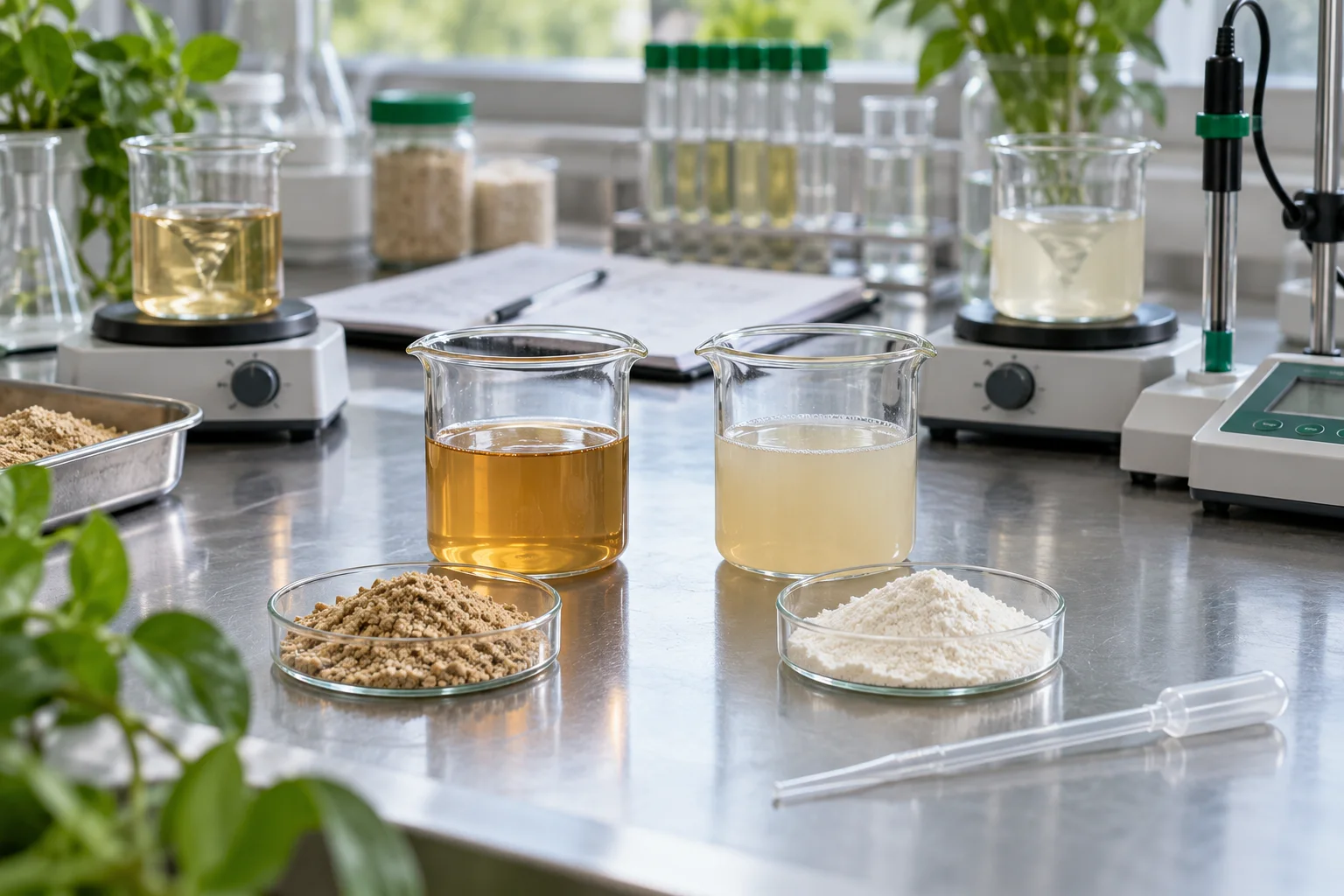
Searches for “enzymatic amino acid fertilizer,” “acid hydrolysis amino acids” and “L-amino acid fertilizer” often lead to a simple claim that one route is universally superior. That shortcut is unsafe for procurement. Protein source, severity of hydrolysis, neutralization, filtration, concentration and drying can all change the ingredient that reaches the formulator.
Enzymatic vs acid hydrolysis at a glance
| Buyer question | Enzymatic hydrolysis | Acid hydrolysis |
|---|---|---|
| How are peptide bonds broken? | Proteolytic enzymes act under controlled pH, temperature and time. | Acid, heat and time cleave proteins; the hydrolysate is then neutralized and processed. |
| Typical composition tendency | Often retains more short peptides alongside free amino acids. | Often contains a higher free-amino-acid fraction and fewer intact peptides. |
| Main process variables | Enzyme specificity and activity, substrate, pH, temperature, time and enzyme stop point. | Acid type and concentration, temperature, pressure, time, neutralization and salt removal. |
| What the route does not prove | Amino acid percentage, L/D profile, solubility, low chloride, crop response, organic eligibility or batch consistency. | |
| Best purchasing evidence | Current specification, batch COA, named test methods, amino acid profile, process statement, impurity limits and a representative sample. | |
A peer-reviewed review in Frontiers in Plant Science describes protein hydrolysates as mixtures dominated by peptides and free amino acids, with chemical characteristics shaped by both protein source and production process. It reports that milder enzymatic processing often gives a higher peptide-to-free-amino-acid ratio, while aggressive acid treatment may alter some amino acids. These are useful tendencies, not a substitute for product-specific data.
What can change in the finished ingredient?
Free amino acids and peptides
A total-amino-acid claim does not reveal how much is free or peptide-bound. Ask for separate total and free amino acid results, then check that the methods and reporting bases are defined. Do not infer a precise peptide percentage by simple subtraction unless the two tests are compatible.
Amino acid profile and stereochemistry
Raw material affects the profile: collagen-rich materials can be glycine- and proline-rich, while plant proteins show different patterns. Processing severity can also affect sensitive amino acids and may influence racemization. A label such as “enzymatic” or “acid-hydrolyzed” does not, by itself, demonstrate an all-L profile.
Mineral residues and formulation load
Acid selection and neutralization can introduce chloride, sulfate or other salts. Enzymatic products can carry minerals or residual components from their feedstock and downstream processing. These factors may affect conductivity, hygroscopicity, tank compatibility and the nutrient declaration. Check the actual COA rather than assuming a route is salt-free.
Match the route to the formulation question
Start with the target product, not a processing slogan. A high-solids liquid, soluble powder, foliar concentrate, fertigation input and peptide-positioned biostimulant may require different balances of concentration, peptide distribution, chloride, pH and dissolution behavior.
- If rapid dissolution is critical: test the proposed use concentration in the actual water, then inspect insoluble residue after a defined time.
- If peptides are part of the product concept: request peptide or molecular-weight information with the method used; total amino acids alone cannot establish a peptide profile.
- If low chloride is required: put a numerical chloride limit in the purchase specification and verify every batch.
- If an L-amino-acid claim matters: request analytical evidence for the claimed stereochemical profile rather than relying on the process name.
- If market approval or organic use is intended: verify the raw material, processing aids and finished input with the destination regulator or certifier. Production route alone is not an approval.
COA and supplier checklist
- Identity: raw-material category, lot number, manufacturing date and traceability statement.
- Process: enzymatic, acid, mixed or other route; major neutralization and purification steps.
- Composition: total amino acids, free amino acids and individual amino acid profile with named methods.
- Formulation properties: total and organic nitrogen, chloride or sulfate where relevant, moisture, pH and solubility test conditions.
- Reporting basis: as-received versus dry basis, units, detection limits and whether values are specifications or one-sample results.
- Compliance: SDS, contaminants appropriate to the raw material and market, and destination-specific declarations.
- Consistency: compare several recent COAs rather than judging the route from a single ideal batch.
A practical bench-validation sequence
First confirm document identity and methods. Next, prepare a proportional bench batch using the real water and co-ingredients. Record mixing order, temperature, pH, clarity, foam and sediment immediately and after standing. Then evaluate storage stability in the intended packaging. Only after formulation compatibility and crop safety are established should agronomic comparisons be made under representative conditions.
This sequence separates three different questions: what the ingredient contains, whether it works in the formulation, and how the finished product performs in use. Hydrolysis route informs all three, but answers none of them alone.
Frequently asked questions
Is enzymatic hydrolysis always better than acid hydrolysis?
No. Enzymatic processing is generally milder and often retains more peptides, while acid hydrolysis may produce a higher free-amino-acid fraction. Suitability depends on the verified composition, formulation target, raw material, process control and batch documents.
Does “enzymatic” prove that an amino acid fertilizer contains only L-amino acids?
No. A process label does not establish stereochemistry or purity. Ask for the amino acid profile, the analytical method and any evidence supporting an L-amino-acid claim.
Which COA values help compare the two routes?
Compare total and free amino acids, individual amino acid profile, total and organic nitrogen, chloride or sulfate where relevant, moisture, pH and solubility under defined test conditions. Confirm units and whether results are reported as received or on a dry basis.
Can hydrolysis method predict field performance?
Not by itself. Performance depends on the complete product, dose, crop, growth stage, application method and environment. Use the process description to guide document review and formulation tests, then validate the finished product in representative trials.
Sources and further reading
- Rouphael et al. — Biostimulant Action of Protein Hydrolysates.
- Colla et al. — Protein Hydrolysates as Biostimulants in Horticulture.
- Everwell — Free vs Total Amino Acids.
- Everwell — How to Read an Amino Acid Powder COA.
Need to compare amino acid powder grades?
Share the target amino acid content, chloride limit, solubility conditions and destination market. Request current batch documents and a sample before approval.