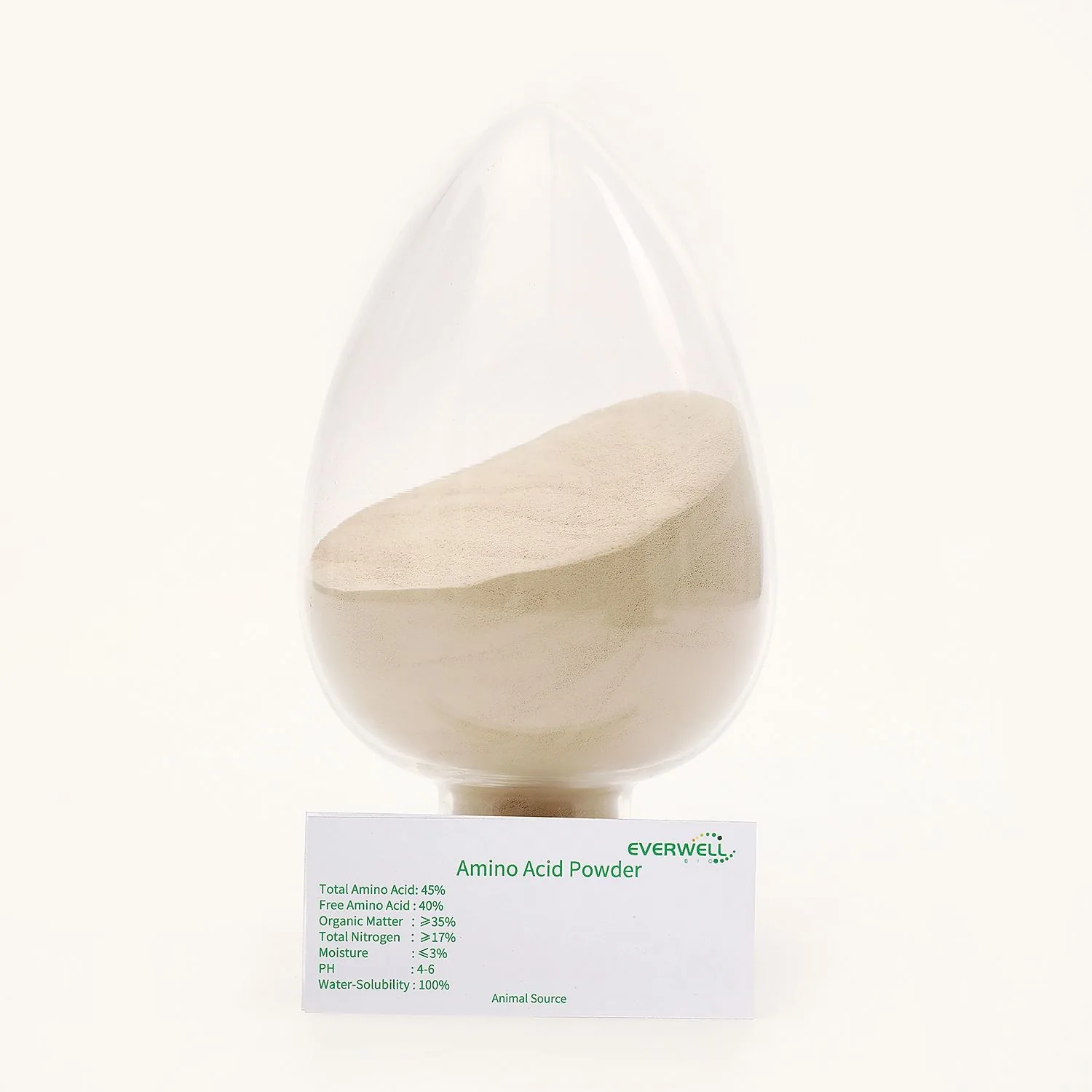
There is no single amino acid fertilizer dose per acre that is correct for every product, crop and application method. Start with the product label or technical data sheet, convert its concentration using the actual spray or irrigation volume, then validate the low end on a small area before wider use.
Quick answer
- Do not copy a rate from another product. A 35%, 45% or 80% amino acid powder does not deliver the same amino acid input at the same product weight.
- For foliar spraying, calculate the area rate from concentration and calibrated water volume.
- For fertigation or soil application, use the supplier's crop-specific area rate and confirm compatibility with the irrigation system.
- A jar test checks physical compatibility; it does not prove crop safety. A small strip or block trial is still required.
Why there is no universal recommended dose
Commercial amino acid fertilizers differ in total amino acids, free amino acids, peptide profile, salts, pH, moisture and added nutrients. Crop species, growth stage, canopy, water quality, weather and tank partners also change the useful and safe range. Published field trials normally evaluate one defined formulation under specific conditions; their rates should not be transferred directly to a different product.
How to calculate amino acid fertilizer dose per acre
When a foliar label gives a concentration in grams per litre, use the calibrated spray volume to convert it to an area rate:
Product rate (kg/ha) = concentration (g/L) × spray volume (L/ha) ÷ 1,000
Product rate (lb/acre) = product rate (kg/ha) × 0.892
Illustrative calculation—not a recommendation: at 1.5 g/L and 200 L/ha, the product rate is 0.30 kg/ha, equal to about 0.27 lb/acre or 4.3 oz/acre. If the sprayer actually delivers 300 L/ha, the same tank concentration becomes 0.45 kg/ha. Calibrate first.
Useful conversions
- 1 hectare = 2.471 acres
- 1 kg/ha = 0.892 lb/acre
- 1 lb/acre = 1.121 kg/ha
- 1% w/v = 10 g/L
Foliar spray, fertigation and soil use are not interchangeable
| Route | How the rate is set | Main checks |
|---|---|---|
| Foliar spray | Concentration × calibrated spray volume | Coverage, leaf sensitivity, weather, spray-water pH and tank partners |
| Fertigation | Product per area or concentration in the irrigation stream | Emitter compatibility, solubility, stock-tank concentration, water hardness and flushing |
| Soil drench | Volume per plant or product per treated area | Root-zone volume, salinity, soil moisture and crop stage |
| Seed or transplant treatment | Only the product-specific labelled rate | Seed safety, contact time, microbial inoculants and local registration |
Factors that should change the starting rate
| Factor | Why it matters | What to record |
|---|---|---|
| Product analysis | Total and free amino acids, peptides, ash and nutrients vary by grade | COA, label, density or moisture basis |
| Crop and stage | Young tissue and reproductive stages can respond differently | Crop, variety, growth stage and target |
| Application volume | The same g/L gives a different dose per acre at a different L/ha | Measured nozzle output and treated area |
| Water and tank mix | Hardness, pH and salts can affect solubility and compatibility | Water test, mixing order and jar-test observations |
| Environment | Heat, low humidity and stressed leaves can narrow the safety margin | Temperature, humidity, wind and crop condition |
A six-step validation workflow
- Read the correct document. Use the current label or supplier technical data sheet for the exact formulation and market.
- Calibrate the equipment. Measure the real spray or irrigation volume per hectare or acre; do not rely on the nominal setting.
- Calculate the area dose. Apply the formula above and document every unit conversion.
- Check compatibility. Follow the labelled mixing order and run a proportional jar test with the actual water and tank partners.
- Run a small-area trial. Start at the low end on a representative strip or block, with an untreated comparison where practical.
- Observe and adjust. Record crop response, leaf injury, residue and yield or quality indicators before scaling up.
Compatibility and crop-safety limits
Jar tests can reveal settling, flocculation, gel formation, heat or separation, but they cannot predict every chemical interaction or phytotoxic response. Use clean water, add products in the specified order, maintain agitation and apply a prepared mix promptly when the label requires it. Avoid treating drought-, heat- or disease-stressed crops unless the product guidance supports that use. When the formulation or tank mix is new, seek advice from the supplier, an agronomist or a local extension service.
Information a buyer should request before approving a rate
Frequently asked questions
What is the recommended amino acid fertilizer dose per acre?
There is no universal rate. Use the exact product label or technical data sheet, calculate from the calibrated application volume, and validate the low end on a small area. A rate from another amino acid grade should not be copied without review.
How do I convert grams per litre to pounds per acre?
First calculate kg/ha: g/L multiplied by L/ha, divided by 1,000. Then multiply kg/ha by 0.892 to obtain lb/acre. The result changes when spray volume changes.
Can the same rate be used for foliar spray and fertigation?
Not automatically. Foliar rates depend on leaf exposure and spray volume, while fertigation rates depend on area, irrigation volume, root-zone conditions and system compatibility. Use route-specific guidance.
Does a jar test prove the tank mix is safe for the crop?
No. A jar test screens physical compatibility only. It cannot confirm biological efficacy or rule out phytotoxicity, so a small crop-safety trial is still needed.
References and practical guidance
- Oregon State University Extension: Nutrient Management for Berries
- Virginia Cooperative Extension: Best Management Practices for Pesticide and Fertilizer Storage and Handling
- FAO: Plant Nutrition for Food Security—A Guide for Integrated Nutrient Management
- Scientific review: Foliar application of amino acids in crops
These sources support calculation, compatibility and validation principles. Any numerical field rate must still come from the exact commercial formulation and local label.
Need a product-specific starting plan?
Share the crop, growth stage, application route, water volume, tank partners and target market. Our technical team can match the request to the correct grade and documentation.