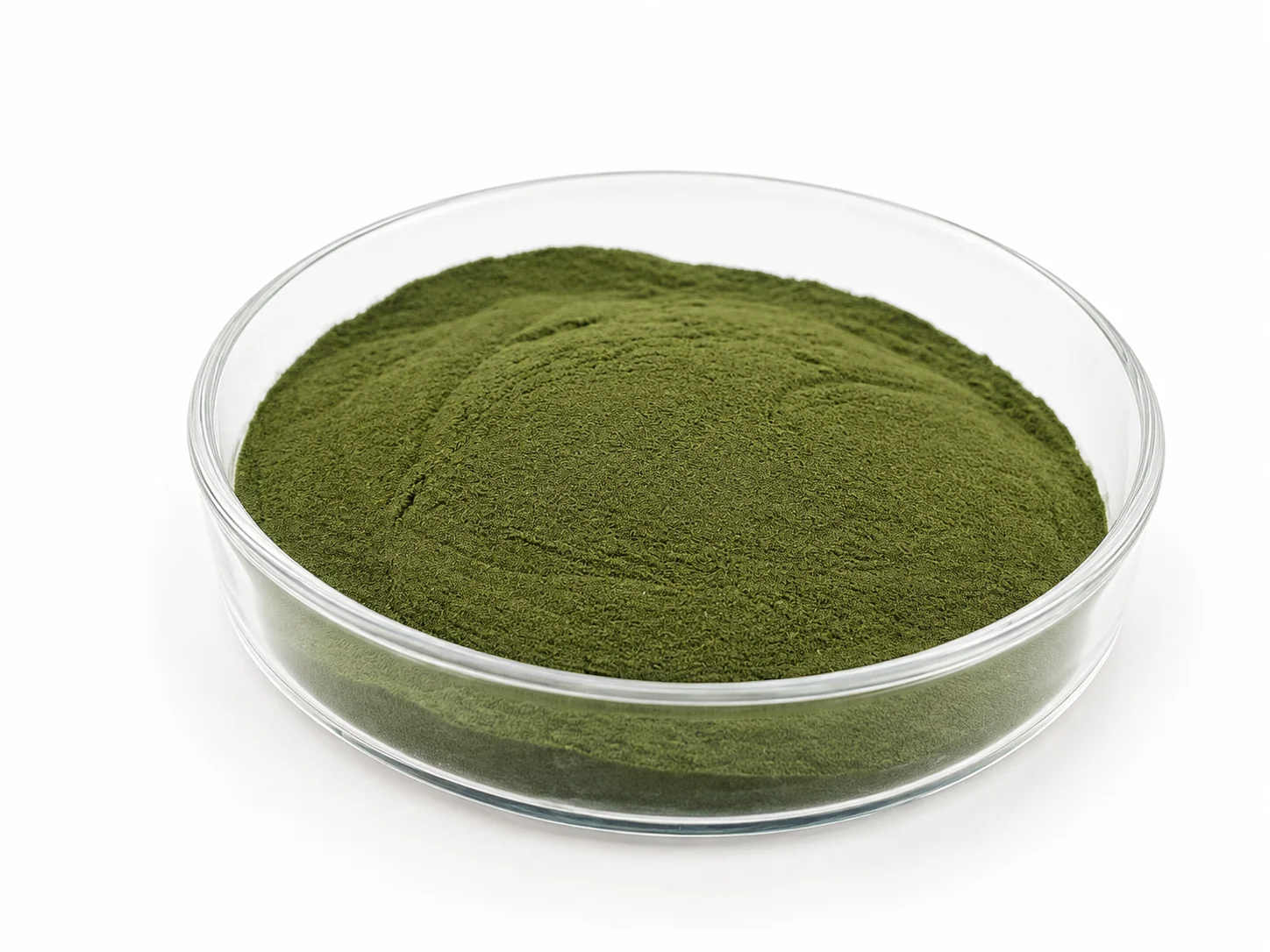
Green seaweed extract powder can be a useful formulation ingredient, but the word “green” is only a visual or commercial description. It does not prove the seaweed species, extraction route, alginic-acid level, crop response or regulatory status. A sound purchase decision combines identity documents, a representative COA, test methods, compatibility work and validation in the intended formulation.
Quick answer
- Use the COA to verify the declared batch—not to infer unreported species, process or field performance.
- Confirm solubility under a defined method and at the real stock concentration, water quality and mixing order.
- Treat foliar, fertigation and soil application as separate formulation and rate decisions.
What does “green seaweed extract” mean?
In online searches, “green seaweed extract” may describe a green or olive powder, an extract made from a green-algae species, or simply a supplier's product name. These meanings are not interchangeable. Botanical identity should come from a species statement and traceability record. Extraction route should come from a process statement. Composition should come from a specification and batch COA.
Species and manufacturing conditions matter because seaweed extracts are chemically diverse. Raw material, season, washing, extraction pH and temperature, concentration and drying can change the final composition. Color is affected by pigments, minerals, moisture, particle size, processing and lighting, so it is a poor standalone acceptance criterion.
How to read the EWSEP30 COA
The analytical values below come from the supplied EWSEP30 certificate tested on 17 February 2026. The appearance description has been updated to the confirmed current product appearance; the remaining values are a batch snapshot and must not be generalized to every future lot.
| Item | Specification | Reported result | Buyer interpretation |
|---|---|---|---|
| Appearance | Green-colored powder | Confirmed | Confirm against an approved retained sample and agreed color range |
| Water solubility | 100% | Conforms | Ask for method, concentration, water and observation time |
| pH | 5-7 | 5.2 | Confirm test dilution and temperature |
| Alginic acid | ≥30.0% | 30.3% | Close to the limit; method and batch consistency matter |
| Organic matter | ≥26.0% | 26.2% | Close to the limit; clarify method and reporting basis |
| Nitrogen (N) | ≥1.0% | 1.2% | Nutrient contribution, not a performance guarantee |
| Potassium (K2O) | ≥20.0% | 20.1% | Check compatibility and declaration rules |
| Total amino acids | ≥4.0% | 4.2% | Does not state free amino acids or peptide profile |
| B / Zn / Fe / Mg | ≥0.5 / 0.5 / 0.4 / 0.5% | 0.53 / 0.52 / 0.41 / 0.52% | Confirm methods, tolerances and local labelling rules |
- Several reported values sit close to their minimum specification. Ask for recent multi-lot data and the laboratory methods before setting acceptance tolerances.
- “100% water solubility” is incomplete without a defined sample mass, water volume, temperature, mixing time, filtration or residue endpoint.
- Total amino acids do not reveal the free-amino-acid fraction, individual profile or peptide molecular-weight distribution.
The COA is useful evidence for one tested lot. It does not by itself prove botanical identity, extraction technology, contaminant compliance, shelf life, compatibility, efficacy or certification eligibility.
What the dispersion video can—and cannot—show
The repaired 33-second video shows EWSEP30 powder being added to water and becoming an olive-colored, visually uniform mixture with mixing. The narration and captions state its limitation explicitly.
Formulation checks before scale-up
Start with a bench batch that reproduces the intended concentrate, dilution water and co-ingredients. Record conditions rather than relying on a photograph of a clear or uniform beaker.
- Define the stock concentration and final use dilution separately.
- Record water hardness, conductivity, temperature and starting pH.
- Add ingredients in the proposed plant-scale order and record mixing energy and time.
- Inspect immediate clarity, foam and sediment, then repeat after standing and temperature cycling.
- Check pH drift, filtration behaviour and compatibility with calcium, phosphates, trace metals, pesticides or microbial inputs used in the final product.
- Repeat the test with more than one production lot before approving a commercial specification.
Foliar, fertigation and soil use require different decisions
| Route | Primary formulation checks | Validation focus |
|---|---|---|
| Foliar spray | Dilution stability, spray-water pH, salts, tank partners and nozzle filtration | Leaf safety, residue, coverage and weather window |
| Fertigation | Stock-tank solubility, hardness, precipitation risk, emitter filtration and flushing | Emitter performance, root-zone salinity and crop stage |
| Soil application | Dilution, soil moisture, salinity and compatibility with the delivery system | Placement, root-zone exposure and local product directions |
| Finished blend | Concentrate pH, preservative system, packaging and temperature stability | Shelf-life protocol and batch release limits |
A practical validation workflow
- Confirm identity. Obtain the species or raw-material statement, process description, traceability and destination-market documents.
- Review the specification and methods. Define every analyte, unit, reporting basis and acceptance limit before comparing lots.
- Run a controlled bench test. Use the real water, concentration, mixing order and tank partners; record immediate and delayed observations.
- Test the finished formulation. Check storage stability, packaging compatibility, filtration and the intended application equipment.
- Validate use. Follow the applicable label or technical document and begin with a small, representative crop-safety and performance trial.
- Monitor consistency. Compare several recent COAs and retain reference samples for color and physical behaviour.
Buyer checklist
Evidence limits and compliance
Research reviews and recent meta-analysis support seaweed-based biostimulants as a category with potential effects on crop growth and stress responses, but the magnitude varies with species, extraction, crop, dose, route and environment. Those publications do not establish a guaranteed response for EWSEP30.
Regulatory treatment also varies by market and claim. In the EU, plant-biostimulant requirements sit within the fertilising-products framework; other countries may use fertilizer, biostimulant or plant-growth-regulator routes. Confirm the exact composition, claims, label and dossier with the destination authority or qualified adviser.
Frequently asked questions
Is green seaweed extract the same as green-algae extract?
Not necessarily. “Green” may refer to appearance or marketing. Confirm the botanical species and raw-material identity separately.
Does 100% water solubility mean the powder will work in every tank mix?
No. The result depends on the test method, concentration, water and mixing. Compatibility with salts, calcium, phosphates, pesticides and other ingredients must be tested in the actual formulation.
Can the COA values be used as a foliar or fertigation rate?
No. A COA describes composition; it is not an application-rate document. Use the exact product guidance and validate each route under local conditions.
Does the green color prove higher quality or more bioactivity?
No. Color can change with pigments, minerals, processing, moisture, particle size and lighting. It cannot prove species, purity or field performance.
Sources and further reading
- Seaweed extracts as biostimulants of plant growth and development (2021 review)
- Seaweed biostimulant manufacturing and extraction technologies (2020 review)
- Meta-analysis of seaweed-based biostimulants and crop outcomes (2026)
- European Commission background on algae and EU fertilising products
The numerical table above comes from the supplied EWSEP30 batch COA. External sources support general interpretation and do not certify this batch or guarantee performance.
Need to qualify a seaweed extract grade?
Share the target market, formulation type, water quality, stock concentration and application route. Request a current specification, representative COAs and a sample before approval.