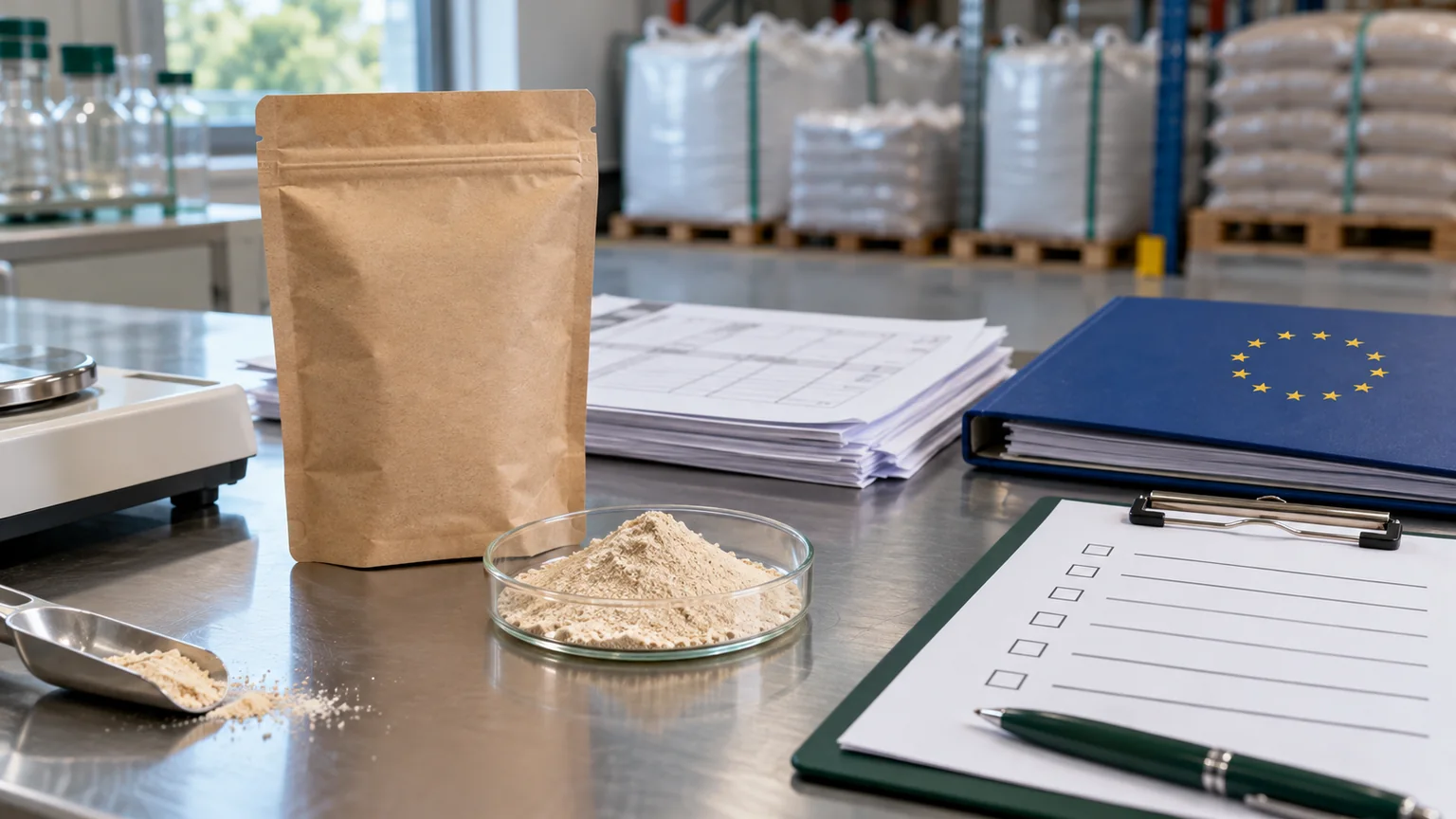
Animal origin does not by itself decide whether an amino acid fertilizer can be sold in the European Union. The importer must first identify the legal route, then verify the product category, component-material eligibility, animal-by-product status, conformity documents, label and traceability. Do not treat a supplier COA or the words “protein hydrolysate” as proof of EU market access.
Quick answer
- Decide first whether the product will use the harmonised EU fertilising-product route or a national non-harmonised route.
- For a CE-marked EU fertilising product, verify the applicable PFC, every CMC, the conformity-assessment route, technical file, EU declaration of conformity, label and traceability.
- For animal-derived inputs, confirm the source category, processing chain and whether the relevant derived product has reached an applicable animal-by-product end point.
- Keep organic-farming eligibility separate from fertilising-product market access; one does not prove the other.
Choose the legal route before requesting documents
Regulation (EU) 2019/1009 creates an optional harmonised route for EU fertilising products. A product outside that route may still be placed on a Member State market under applicable national rules, but the conditions and mutual-recognition analysis are different. The importer should not mix the two routes in one checklist.
| Question | EU fertilising-product route | National route |
|---|---|---|
| Market basis | Regulation (EU) 2019/1009; CE marking after applicable conformity assessment | Destination Member State law; mutual recognition may be relevant |
| First classification | Identify the product function category (PFC) and all component material categories (CMCs) | Confirm the national product category, registration or notification requirements |
| Core file | Technical documentation, conformity assessment, EU declaration of conformity, label and traceability | National dossier, label, composition and evidence required by the destination authority |
| Key caution | A raw material is not automatically an eligible component because it has agronomic value | Acceptance in one country does not automatically establish acceptance everywhere |
Why animal-by-product status and an end point matter
Animal-derived proteins can fall within the EU animal-by-product framework. The importer should obtain a raw-material statement, species or source-category information where relevant, the processing description, establishment and traceability records, and evidence supporting the claimed regulatory status. Transport and import controls may apply before an end point is reached.
An end point means that a derived product has completed specified treatment and control conditions so it can move from animal-by-product controls to the other legislation governing its intended use. It is a legal status tied to a defined material and route—not a synonym for hydrolysis, sterilisation or a microbiological pass result.
CMC eligibility: verify the current legal text, do not assume
For the harmonised EU route, every component must fit an allowed CMC and meet its conditions. CMC 10 covers certain animal by-products as defined by the fertilising-products rules. Eligibility depends on the current table and conditions, not merely on the fact that a material is a processed protein hydrolysate.
The Commission has continued to assess additional derived products. A draft or consultation document is not enacted law. Importers should check the consolidated regulation in force on the intended placing-on-the-market date and, when classification is uncertain, obtain advice from the competent authority or a qualified EU regulatory specialist.
Importer duties under the EU harmonised route
Article 8 of Regulation (EU) 2019/1009 places active duties on the importer. A supplier declaration does not replace the importer's own verification.
- Confirm the economic operators. Identify the manufacturer, authorised representative where used, EU importer and distributors; verify names and contact details on the required documents and label.
- Check classification and conformity. Review the claimed PFC and CMCs, applicable conformity-assessment module, notified-body involvement where required, and the completed EU declaration of conformity.
- Check the technical and batch evidence. Confirm that the technical file supports composition, safety, claimed function and applicable limits; link the imported lot to the COA and traceability record.
- Review the label before release. Check mandatory particulars, language, nutrient declarations, instructions, warnings, storage information and operator details for the destination market.
- Control storage and transport. Ensure conditions under the importer's responsibility do not jeopardise conformity and document deviations.
- Retain records and cooperate. Keep the declaration and required documentation for the applicable period and provide information to market-surveillance authorities when requested.
Private label and repacking can change responsibilities
An importer or distributor can assume manufacturer obligations when placing a product on the market under its own name or trademark, or when modifying a product in a way that may affect conformity. Repacking, relabelling, blending or changing instructions should therefore be assessed before commercial launch—not treated as a simple marketing step.
Define in the supply agreement who owns the formula and technical file, who controls changes, who approves artwork, how complaints and recalls are handled, and how batches remain traceable after repacking.
Buyer document checklist
Red flags before purchase
- The supplier says “EU compliant” but cannot name the legal route, PFC or CMC.
- The CE mark appears only in a brochure and is not linked to a finished product and declaration of conformity.
- An end-point claim is supported only by a process description or microbiological COA.
- The batch COA has no method, reporting basis, lot link or acceptance limits.
- Organic eligibility, CE marking and national registration are presented as the same approval.
- A 2026 proposal or draft is cited as if it were already binding law.
Market access is not organic-farming eligibility
EU fertilising-product conformity and eligibility for use in organic production are separate assessments. Organic use depends on the applicable organic-production rules, the material, conditions and the certifier or competent authority. Avoid broad claims such as “EU organic approved” unless the exact product and evidence support them.
Frequently asked questions
Can an animal-derived amino acid fertilizer be sold in the EU?
Potentially, but not automatically. The operator must select a valid EU or national legal route and satisfy the material, product, documentation, label and traceability requirements for that route.
Does hydrolysis prove that the material has reached an animal-by-product end point?
No. An end point is a legal status under specified conditions. Hydrolysis or a microbiological pass result alone does not establish it.
Does a supplier COA prove CE compliance?
No. A COA is batch evidence. CE compliance for an EU fertilising product also requires correct classification, eligible components, conformity assessment, technical documentation, an EU declaration of conformity, compliant labelling and traceability.
Can a private-label importer rely entirely on the original manufacturer's documents?
Not safely. Using the importer's own name or trademark, repacking or modifying the product can shift or expand responsibilities. Review the exact operation and contracts before launch.
Official sources
- Regulation (EU) 2019/1009 on EU fertilising products
- Current consolidated text of Regulation (EU) 2019/1009
- European Commission: animal by-products
- European Commission: end points in animal-by-product regulations
- Commission Delegated Regulation (EU) 2023/1605
- Your Europe: CE marking
This guide explains a due-diligence workflow and is not legal advice or a product conformity decision. Check the law in force and the destination authority before placing a product on the market.
Qualifying an amino acid fertilizer for an EU market?
Share the destination country, intended product category, composition and private-label plan. Request a specification, recent COAs and the supporting document set before approval.