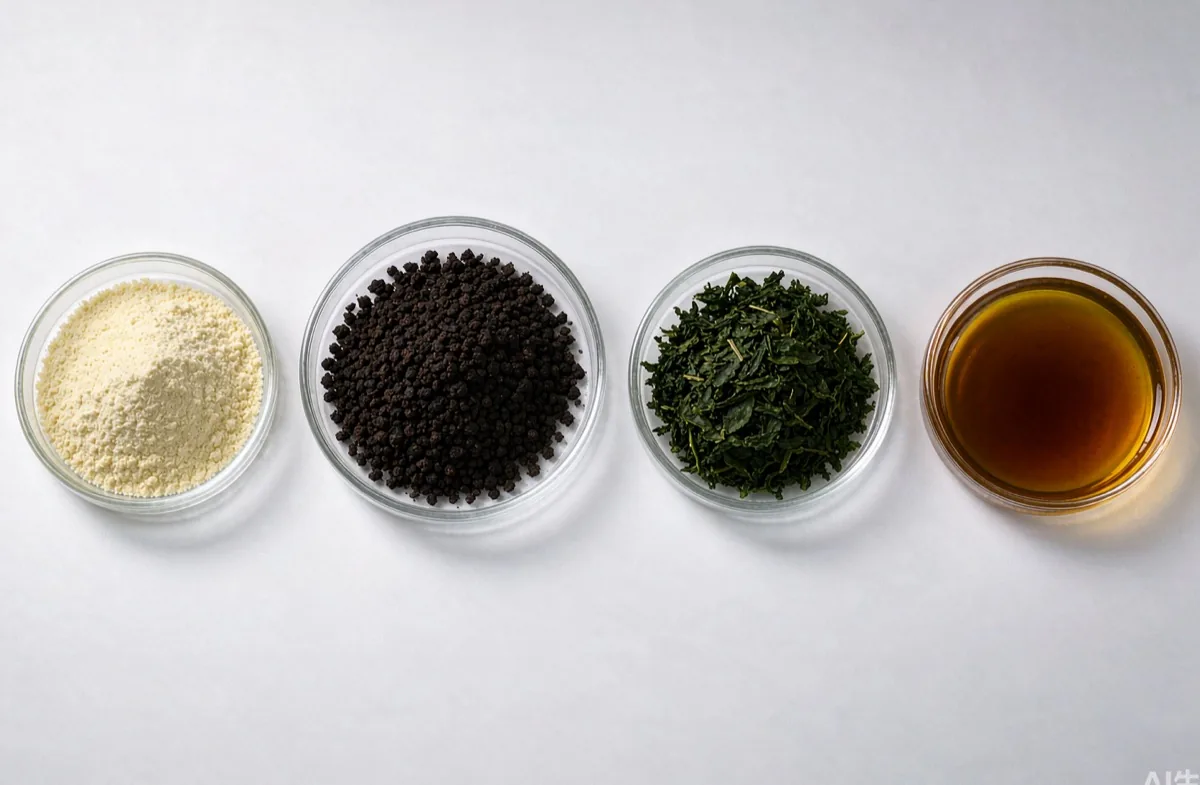
Amino acid powder, humic substances, seaweed extract and fish hydrolysate are often grouped under the broad term “biostimulants.” They are not interchangeable. Their composition, intended role and evidence base differ, and products within the same category can also vary widely.
There is no universal winner. The appropriate choice depends on the formulation objective, crop, soil or substrate, application method, water quality, regulatory status and verified composition of the exact product.
Quick comparison
| Product category | Main components | Common formulation objective | Important buyer checks |
|---|---|---|---|
| Amino acid powder / protein hydrolysate | Free amino acids, peptides and nitrogen-containing compounds | Amino acid and organic-nitrogen contribution; nutrient-use and stress-support formulations | Total vs free amino acids, nitrogen, salts, origin, hydrolysis method |
| Humic and fulvic substances | Heterogeneous organic molecules from leonardite, lignite or other sources | Soil, root-zone and nutrient-availability formulations | Test method, humic/fulvic definition, pH, potassium, ash, solubility |
| Seaweed extract | Seaweed-derived carbohydrates, minerals and other compounds | Crop-quality and abiotic-stress formulations | Species, extraction process, solids, alginate/mannitol markers where used, salts |
| Fish hydrolysate | Peptides, amino acids, nitrogen and variable oil/mineral fractions | Organic-nutrition, soil and specialty foliar products | Raw material, hydrolysis, protein, amino acids, oil, odor, microbiology, stability |
These are category-level descriptions. A supplier’s specification and the final product’s registration determine what can be claimed.
Amino acid powder and protein hydrolysates
Protein hydrolysates are produced from plant or animal proteins using chemical, enzymatic, thermal or combined processes. The result may include free amino acids, peptides and other soluble materials.
Research reports possible effects on nutrient-use efficiency, root development and abiotic-stress responses. The magnitude and direction of the response depend on composition, concentration, crop and environment. Excessive amino acid concentrations may inhibit growth in some situations.
Use amino acid powder when the formulation requires a defined amino acid contribution and when its analytical profile and compatibility have been verified.
Humic and fulvic substances
Humic products are commonly used in soil and root-zone formulations. Their effects are associated with soil chemistry, nutrient availability, root development and plant signaling, but commercial products differ significantly by source and extraction method.
Do not compare products using “humic acid percentage” alone. Test methods are not always directly comparable, and potassium content, pH, ash and insoluble matter can influence formulation behavior.
Seaweed extract
Seaweed extracts contain complex mixtures whose composition depends on species, harvest conditions and extraction. Published research reports potential effects on plant growth and stress responses, but it is inaccurate to describe every seaweed extract as a standardized hormone product.
Buyers should request the seaweed species, extraction process, solids content, relevant marker compounds and salt profile. Performance claims should be based on the exact extract or finished formulation.
Fish hydrolysate
Fish hydrolysates may contain peptides, amino acids, nitrogen, minerals and residual oil. They are not simply liquid versions of a high-free-amino-acid powder. Composition, odor, microbiological controls and storage stability require separate evaluation.
Potential agricultural, feed or organic-production uses depend on product-specific documentation and destination-market rules. “Fish source” alone does not establish eligibility.
How to choose by formulation objective
If the objective is an amino acid contribution
Compare total and free amino acids, nitrogen, peptide profile where available, salts, pH and solubility. Amino acid powder or a standardized protein hydrolysate may be the most direct candidate.
If the objective is root-zone or soil formulation
Humic substances may be relevant, but the decision should reflect soil type, irrigation method and the analytical definition used for the humic material. Protein hydrolysates or fish products may also be considered as part of a broader program.
If the objective is a seaweed-based formulation
Choose by species, extraction, solids and formulation stability—not by the word “seaweed” alone. Validate the intended benefit in crop trials.
If the objective is an organic-nutrition input
Check the exact permitted-input rules, current certificate or listing and animal-source restrictions. None of the four categories is automatically accepted under EU, OMRI, JAS or another program.
Can these products be combined?
They can be evaluated in combination, but compatibility is not guaranteed. Combining multiple soluble products can change pH, ionic strength, precipitation, foam, odor and storage stability.
Use the following sequence:
- Review each product’s TDS and SDS.
- Check the intended concentration and water quality.
- Run a jar test using the actual mixing order.
- Observe precipitation, heat, gas, odor, foam and pH change.
- Conduct a crop-safety test before broad application.
Avoid publishing universal tank-mix recipes. Crop-protection products and concentrated calcium, phosphate, copper or alkaline materials require particular care.
Cost comparison
Compare cost per hectare only after determining the required dose and verified active content. A low price per kilogram may hide low concentration, high salts or poor consistency. A high-concentration product may reduce freight or formulation space but may not provide a better agronomic return.
A useful comparison includes:
- cost per kilogram of the required component;
- verified application rate in the final formulation;
- packaging and freight;
- stability and filtration losses; and
- crop response from relevant trials.
Conclusion
Choose a biostimulant ingredient by the problem the finished formulation is intended to address and by verified product data. Category names are useful starting points, not proof of composition, compatibility, organic eligibility or field performance.
References
- Biostimulant Properties of Protein Hydrolysates
- Biostimulant Action of Protein Hydrolysates
- EU rules for products and substances used in organic production
Need help designing a biostimulant program for your crop?
Tell us your crop, soil type, current program, and the problem you want to solve. We will reply within 24 hours with a tailored biostimulant plan and a free 1 kg sample of the right grade.